
A Conversation with Tori Rego
Tori Rego is a writer from Charleston, South Carolina. She currently lives in Chicago where she hosts the monthly reading series Written on a Napkin. Her poetry chapbook Briefly, Gently was recognized as a finalist for the Chicago Reader's Best New Poetry Book by a Chicagoan in 2024. A complete list of her published work can be found at www.torirego.com.
Tori’s poem, “Bedtime Prayer,” can be read in Issue no. 1 of Sabr Tooth Tiger Magazine.
“I think this is something that's really lovely about poetry, more generally, is that it is so contained […] what a poem seems to do well is a moment or breath.” —Tori Rego
Jason Nimako: I really enjoyed “Bedtime Prayer.” It felt like a moment glimpsed through a cracked bedroom door. What is it that draws you to write a particular thing and know that it is a moment or an idea you want to put down on paper?
Tori Rego: Sometimes I really want to write a poem, so I'll sit for a while and start putting down images or words and just let associations go. But, more likely than not, it's something that has come to me already as worthy and needing. Something needing to be written about.
This one, particularly, is one of the first of a series of poems that's now coming up on a full book of poems about angels. I had the thought of writing about angels when I was just thinking about my mother one day, and this painting that she had in our living room when I was a girl, of a group of cherubs. I think it was a blown-up Michelangelo, just a section of it.
I was thinking about that painting, and thinking about how much she loved angels, and from there, a bunch of different iterations on Angel poems came out.
Jason: Okay, that actually goes to so many other questions I had, because this feels so visually evocative. Would you say that painting was a heavy touchstone for “Bedtime Prayer” or the collection you're making? What started that ball rolling?
Tori: I'd say that I am a pretty visual thinker. More generally, I tend to think in images and then create image and word pairs. You know, when you're in school, and you have to make, like, a word cloud, and it's all these associated words for a subject?
Jason: Yes, word collages?
Tori: Yes, I kind of feel like I think like that, but it's words and little pictures of things. One of the little pictures I have in my head when I'm writing all of these is definitely that painting, but it's also a few different movies that I think about that go way back to my childhood. And there are some other famous paintings, and also more campy pop culture things that I'm thinking about a lot.
All of those are images in my head. This one, particularly, is really about a visual experience, because it's about being a child and imagining a visitation.
Jason: I notice you play with structure and spacing in an interesting way, and I’ve noticed it in a couple of your other pieces as well. I'm wondering, when in the process do you start to think about it?
Tori: I pretty much always start poems the same way, as one big block of prose. Usually, I'm writing by hand these days at a cafe, so oftentimes, I'll just pull a piece of paper from our receipt printer, and I'll just start writing it like a sentence. I won't try to put any line breaks or anything. It'll just be like, one thought follows another, and there isn't a thought yet about structure. I just let the words and the narrative guide the first pass of writing.
Once I've got that first draft out, which is now just like a block, then usually I either take it and write it out again by hand, or I'll take it and bring it to my laptop. That's when a form starts to be brought to it, and usually the first form is pretty generic. Then from there, once I've got it in that kind of basic poetic form, it's an intuitive process of, “okay, this poem needs more like emptiness on the page.” So maybe the lines should be shorter, and it should fall further down the page. Or maybe it needs to feel more cascading. Or maybe I'm noticing a lot of punctuation, so I need to put some spaces in to denote punctuation instead.
Jason: There's a different texture to having the actual period or comma there.
Tori: Yeah, so with this one, if you can imagine it originally as a big block of just sentences, there probably were commas and periods that became various amounts of space.
Jason: Okay, so when you're writing, the first draft is often on receipt paper?
Tori: Yeah, yeah, or my journal. I do try these days to write drafts, especially poems, by hand. It's just they're there already at your fingertips, and it feels like there's less between you and a piece of paper than there is between you and a laptop. Like it's a less formal feeling. So just being able to grab a scratch, and this is a silly thing, but I guess for some reason, writing on a small sheet feels…
Jason: Less intimidating?
Tori: …Yeah, more approachable. So I like the receipt paper because it's so tiny. I fill one up fast, and then I rip the next one, and it feels really impermanent, and I can flip through them, and I tuck them in my pocket, and then take them back out. They're just really accessible right there, and ready.
Jason: What's it like when you're sitting down to write?
Tori: These days, a lot of my poetry writing is happening while I'm doing other things. I'm sometimes on transit. Sometimes, a lot of the time, I'm at work. Sometimes I'm out at a cafe or bar or something.
Jason: Do you write with music?
Tori: I'm not really one for putting headphones in when I'm out in public. I just listen to whatever ambient noise is going on around me. I find that I can zone into an artistic project pretty well without needing to highly curate the listening. But if I'm at work, it's probably early in the morning. 7:00 or 8:00 AM, and there are very few people in my cafe. I'm probably listening to jazz because one of my big goals for this year is to learn more about that genre of music. So, probably got something going like that in the background.
Jason: For “Bedtime Prayer,” would you say the first draft came out of you very easily, or was it a more labored thing?
Tori: Yeah, I think this did come out really easily, because this was maybe the second or third poem on this theme that I wrote. Every time I would sit down to write on it, I would feel like I wasn't finished yet, like there was another facet, another angle to explore. So I'm already turning over this in my mind, and I've set some things down. It's really easy to then just pick it back up and get back in. With this one, I had a really clear starting point, which was when I was little and would imagine being visited by a guardian angel.
It was simple to set that feeling and that moment on the page, and then see where it brought me.
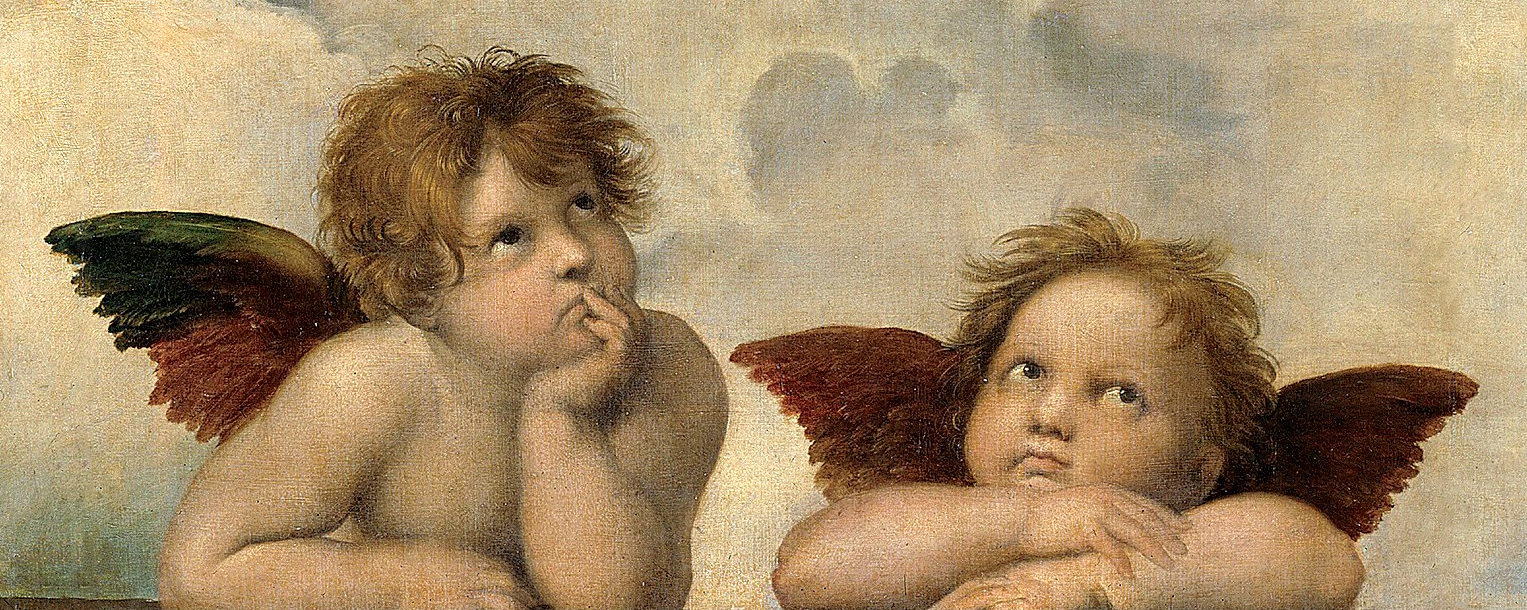
The painting referenced: Two Cherubs from the Sistine Madonna (1513).
Jason: Regarding angels, do you believe in them or anything metaphysical?
Tori: You know, it's so funny because I'm writing so much about them, but to do this as an artistic project, I had to put that question to the side. Not concern myself with whether or not these things exist, and more of what they mean.
Jason: So when you're writing, because you're playing with this theme of angels in several other pieces, does it feel easier to write because you don't have to get everything out in this piece, and you can explore the idea later in other pieces, or do you feel even more precious about each thing you write?
Tori: Yeah, I do feel like it's easier, and it lets some pressure off, because you know each poem, and I think this is something that's really lovely about poetry, more generally, is that it is so contained. I don't know if you write too or, like, do an artistic practice, but when you try and sit down and write a longer work, it does feel like you are having to contain so much, whereas what a poem seems to do well is like a moment or breath, you know?
And so you're really zoning in on something specific. Especially when you find yourself drawn to a theme or a subject, and you give yourself permission to return to it again and again and again. You keep digging up more nuance and more strangeness about that, and the more you let yourself dig into that, the richer it gets. But it does take some of the pressure off, because maybe in this poem I'm only exploring angels as warriors, whereas in another one, I'm exploring angels and the idea of forgiveness. You can just really see that one detail and all of its particularity.
Jason: My last question, because I also write myself, I never feel like anything I write is ever finished. Do you ever get the feeling of finality? When you read “Bedtime Prayer” now, is it done for you? Or do you see little things you could tweak still?
Tori: Oh, definitely, because I'm working on the full manuscript of these poems, and this is part of it. I did shift a couple of lines. I think, and I've heard this from other writers too, it's never like the thing is done, it's just done for now, right? And you just decide that this version of me has taken this thing as far as I can, and that is going to have to be okay.
Jason: I'll be keeping an eye out for this collection. Do you know what it will be called?
Tori: Right now, the working title is The Choir Sings, but I don't know. It might change.

The debut issue of Sabr Tooth Tiger Magazine. 6×9 paperback, 134 pages.
Poetry by: David Agyei-Yeboah, Maude B., Madeline Blair, Ace Boggess, Ashlee Craft, Zach Crosswait, Zoë Davis, Gavin DuBois, Mal Grace, Erica Hasselbach, Asmi Kartikeya, Daithí Kearney, Maëlle Keita, Ayesha Khan, Emma Lee, Juan Madrigal, Faisal Mohyuddin, Phoebe Nerem, Benjamin Niespodziany, Vaghawan Ojha, Samuel Plauché, Colette Postaer, David Raygoza, Tori Rego, Maddy Rowe, Patricia Russo, Satori, Ayden Scott, Brandon Shane, Sameen Shakya, Anca Varvara-Piccozzi, Ethan Viets-VanLear, Rebecca Watson, Jenny Whidden, gray lindsey, Ammara Younas, Zaid Zaheer
Prose by: B.E. Austin, Johnzee Baptiste, Rohit Karir, Sara Muttar, Sarah R. New, Anna Nguyen, Farhan Nurdiansyah, Eli Sugerman, Dylan Terry
Art by: Fatima B., Bea Bouman, Nathan Doty, Bushra Khan, mahnoor, Zafar Malik, Stefanie Reinhart
Please note that copies are printed-to-order and can take up to one month to be delivered.